Showing posts with label SDE. Show all posts
Showing posts with label SDE. Show all posts
Saturday, October 13, 2018
Testing out my new Foldio360
This is the first "image" taken using my new Foldio360 turntable and light studio. It uses my iPhone and Bluetooth enabled turntable. Using the app, it takes 24 (or more) shots as it rotates the object 360 degrees and then stitches them together into the interactive image. It took me very little time to set up and appears to have worked well on the first go around. I did notice that I didn't center the miniature very well and it seems that she rotates around her left foot rather than the very center of the base. I thought I had marked the center on the turntable and placed the mini on the correct spot. I'm guessing that this will continue to be an inexact science. I probably need more practice.

Saturday, July 30, 2016
More Super Dungeon Explore w/ an Airbrush Warning


Saturday, August 25, 2012
Super Dungeon Explore: Part 3


Thursday, August 16, 2012
Super Dungeon Explore: Part 2
Unlike other dungeon crawling games like Descent or Warhammer Quest; Super Dungeon Explore uses large square dungeon tiles, that fit flush together along their edge, to represented the layout of the dungeon. Descent and Quest use irregular shapes that often touch only a few neighboring pieces so the negative spaces between the tiles represent walls or null zones that the characters cannot move or see through. On the SDE boards, the walls and such are drawn onto the map.Unfortunately, they are not always easy to see and determining line of sight and movement paths can be tricky. I am not the first and only person to feel this way, nor the first person who thought it might be fun to fix that problem by adding 3 dimensional features on the board to represent the sight-blocking nature of the room's objects. The following link shows one of the more extreme examples; where the maps have been completely recreated with painted plaster terrain: tabletopgeeks .
Although I thought it would be fun to explore the wonderful world of mass plaster production, I still have 30+ more models to paint and a host of other projects that also want my attention. Therefore, I selected a solution somewhere in the middle. I continue to use the colorful cardboard tiles, but I have recreated the 3-dimensional elements with carved and painted polystyrene foam. The foam took about 26 hours to shape and 10 hours to paint.
The pictures below show the hot wire cutter I used to cut the straight geometrical shapes. A tinfoil ball rolled over the surface of the foam was used to create a stone-like texture. The bricks and other shapes were made with a very sharp exaco knife. Inexpensive acrylic craft paints were dry-brushed on for the color. The other pictures show the final outcome of the more interesting map sections. A picture of the map's art is given on the left side of each image for reference. Recreating the illumination of the lava and crystals from the map onto the 3D parts was a lot of fun. The final picture shows an example of each of the three wall connectors used between the map tiles to mark the dividing walls. I left them modular to allow for variable shape combinations among the tiles.


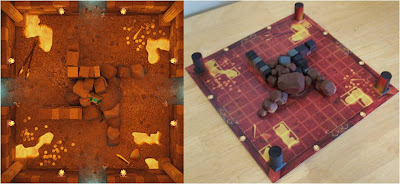


Although I thought it would be fun to explore the wonderful world of mass plaster production, I still have 30+ more models to paint and a host of other projects that also want my attention. Therefore, I selected a solution somewhere in the middle. I continue to use the colorful cardboard tiles, but I have recreated the 3-dimensional elements with carved and painted polystyrene foam. The foam took about 26 hours to shape and 10 hours to paint.
The pictures below show the hot wire cutter I used to cut the straight geometrical shapes. A tinfoil ball rolled over the surface of the foam was used to create a stone-like texture. The bricks and other shapes were made with a very sharp exaco knife. Inexpensive acrylic craft paints were dry-brushed on for the color. The other pictures show the final outcome of the more interesting map sections. A picture of the map's art is given on the left side of each image for reference. Recreating the illumination of the lava and crystals from the map onto the 3D parts was a lot of fun. The final picture shows an example of each of the three wall connectors used between the map tiles to mark the dividing walls. I left them modular to allow for variable shape combinations among the tiles.


Tuesday, August 7, 2012
Super Dungeon Explore. Part 1

The above pic shows the first 6 models (heroes) painted in my newest minature game, Super Dungeon Explore. I was introduced to and purchased this game at Origins back in June. Apprently, Sodapopminiatures had just released the second printing of the game and I got one of the first copies. Changes in the new release include the replacement of the metal hero models with these fantastic plastic ones. Other blogs show that the newer models are also a little bit larger.
I immediately fell in love with these minatures after seeing the display booth at Origins and examining the images on the box. My miniature painting style had taken on a cartoony-ness over the past 5 years and these models would definatley accentuate that more than the "realistic" sci-fi models (40k) I had been working on. I am very pleased with how these first six came out. I think that my high contrast blends and hardlined boarders and edges replicate the techniques used by comicbook artists and makes these models look very similar to their fantastic art work.
The box came with 40 models; 9 of them heroes; and all of them gorgeous. I can't wait to see how the rest turn out.
Subscribe to:
Posts (Atom)